
Mr. Minister,
Before writing my article, I had tried to reach you, but it is hardly easy. There is indeed no website dedicated to the Ministry of the City and Housing, which would have allowed me to contact your communication service or to understand how your email address was configured. Nevertheless, I contacted you via your Twitter account, which you update regularly. You were therefore aware of my request, and chose not to respond to a journalist about a bill that you want Parliament to vote on. On the other hand, you have just, in an opinion piece published on your LinkedIn account, given an answer to the op-ed that I co-signed in Le Figaro with Stéphane Bern along with several heritage protectors, politicians and association leaders.
Not knowing any better today how to reach you directly, I am therefore publishing, on my website, and with free access, a response to your response, in the form of an open letter. You are indeed trying to justify the nefarious law you want to pass, which is destructive to a centuries-old heritage that, clearly, hardly interests you.
In reality, what you say in this text makes absolutely no sense, which is quite embarrassing for a minister. I will therefore examine your arguments one by one.
No one is fooled by your introduction. Claiming that "the mission of the Architectes des Bâtiments de France is essential" when you want to reduce this mission to nothing, or almost nothing, is at best taking your interlocutors for fools, which they are not, I would like to reassure you on this point right away.
Explaining next that "in a democracy, experts enlighten the decision. They do not substitute for it" is worrying and shows that you have a strange conception of democracy. Mayors cannot, and fortunately so, do whatever they want under the pretext that they were elected. Rather than democracy, such an attitude is indeed the beginning of dictatorship. As for the préfets — who, let me remind you, are not elected — why would they have more legitimacy for certain decisions than experts, in fields in which they are not specialists? The role of the ABF was defined by a 1946 law. Are you claiming that, since that date, heritage protection has not been democratic?
This argument that elected officials or préfets are legitimate to do whatever they want without following the advice of experts is furthermore contradicted in a very large number of areas. It is thus impossible for an elected official or even the Minister of Health to authorize the marketing of a drug. This authorization must be issued by the Director General of the Agence nationale de sécurité du médicament et des produits de santé, who relies, obviously, on the studies carried out by the experts of his agency.
In the nuclear field, nothing can be done without a commissioning authorization given by the Autorité de Sûreté Nucléaire et de Radioprotection; in that of aeronautics, the authorization to fly an airplane falls under the Direction générale de l’aviation civile, notably. In all these cases, it is indeed experts who decide, and fortunately so. I could multiply the examples. It is true that some leaders claim to have all the rights, against the experts, but this is seen more in dictatorships than in democracies.
Admittedly, mayors can make decisions that nevertheless relate to public safety. For example, even if the safety commission, made up of experts, gives a negative opinion on the opening of an establishment open to the public, the mayor can nevertheless authorize it. But in the event of an accident, their liability would be heavily engaged, which leads de facto to regulation, transforming this non-binding opinion into an almost binding opinion. On the other hand, if a mayor decided to override the opinion of an Architecte des Bâtiments de France, he would run no risk other than that of the opprobrium of heritage defenders... A prospect that does not seem to scare you much.
Let us remember that Donald Trump recently urged the president of FIFA not to follow the advice of the expert, the referee of the United States–Bosnia and Herzegovina World Cup match, and to let the American soccer player Folarin Balogun play. Do you support the president of the United States, who was elected, for not letting himself be impressed by the referee? This would be logical after all, but I doubt this is the case. Yet the ABF is a referee, whose role and importance are significantly more essential.
Using the pretext, as you do, of the housing crisis to want to reduce the power of the ABF is, coming from you, a minister of Emmanuel Macron, quite rich. Because this crisis is, according to all observers, due to multiple causes, some of which originate from his various governments.
First of all, the DPE, whose calculation has been abundantly proven to be unreliable. You seem to have identified this point, since you want to loosen this constraint. But by forcing owners who want to rent out F or G-rated housing to commit to carrying out these overpriced works, which are often useless and sometimes also destructive to heritage, you are only pushing the problem back and this will in reality have only a marginal effect. A DPE, moreover, which has never taken into account the thermal summer heat phenomenon that you denounce in your text, since until now it was essentially only about insulating from the cold. Testimonies are multiplying, during heatwaves, about homes brought up to standard that become almost uninhabitable during peak temperatures.
Next, the impossibility of easily recovering one’s property when the tenant does not pay their rent, or when it is squatted. While your government is not the only one responsible for this situation, it is doing nothing to oppose it. And as this situation worsens, coupled with the laxity of the justice system, it prompts many owners to withdraw their properties from the market, or not to invest in housing that they could not pay off if their tenant stopped paying.
Other factors obviously come into play, which again have nothing to do with the ABF, such as the cost of construction, the rise in interest rates, or rent controls, which are known to discourage renting as well, and which some mayors nevertheless put into practice, as in Paris.
In your text, you again take the example of shutters, which the ABF would refuse to authorize the installation of. How can one, when one is a minister, ignore reality to such an extent? No, the ABF obviously do not oppose shutters. They encourage them, quite the contrary, because it is part of the identity of our heritage. France, in the 18th century, was a pioneer in the field of louvered shutters, of "Persian-style jalousies" as the French carpenter of the time, André-Jacob Roubo, wrote.
Those they refuse are these rolling PVC shutters, unsightly, very poorly protective against heat, and furthermore dangerous in the event of a fire, due to the fumes from their combustion and because an electrical failure can prevent residents from leaving quickly. Wooden shutters, those that adorned many buildings and which are often, precisely, replaced by PVC, are not the enemies of heritage, quite the contrary, and the ABF encourage their installation. As for the buildings — there are some — that cannot have external shutters because their architecture opposes it, it is possible to install internal shutters, also made of wood, which cannot be seen from the street, and which protect perfectly against the heat of the sun.
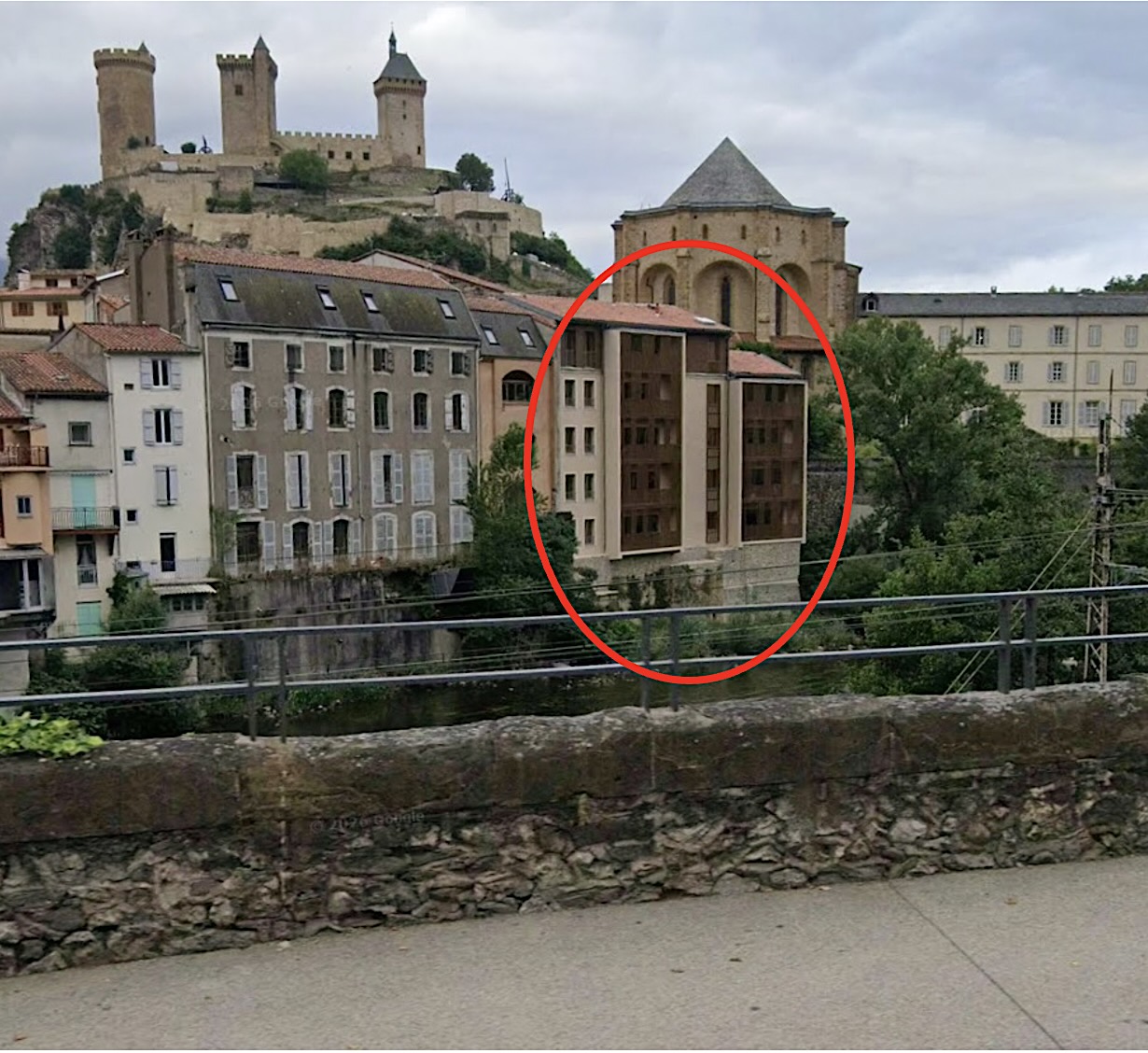
Recent construction replacing old buildings destroyed in the remarkable heritage site, against the opinion of the ABF, and thanks to the Élan law.
Photo: Google Streets
It must be added that the opinions of the ABF, which would prevent the construction of homes, concern only 6% of French territory, and result in a refusal in only 7% of cases, a percentage reduced to 0.1% in the end, after discussion between them and the owners. In reality, most ABF always try to find solutions, because they are professional architects capable of intelligently adapting to current standards. There may be excesses of course, as in all human decisions, but these are rare, and balance out: a few ABFs will be too strict, others (this is the case in Paris), too lax. But you will not change the very low percentages we have quoted, which alone prove that the ABF are in no way responsible for the housing crisis.
Who can believe, moreover, that making the opinions of the ABF ineffective on shutters would boost construction. Everyone has understood that your law is above all aimed at allowing the destruction of old buildings in remarkable heritage sites or in the perimeters of historic monuments, which has moreover begun thanks to the Élan law voted by a previous government of Emmanuel Macron (ill.). Is this what you want?
You claim that behind the facades of these old buildings no one could live or protect themselves from the heat anymore. Yet they are, precisely, both the best adapted to high temperatures (which no one really worried about until recent weeks) and to the cold, because they are built with very resilient materials, much more so than concrete. We have known for a long time (but it is true that it is the experts who say so and that they are bound to be wrong compared to elected officials like you who have infused science) that the main insulation problems are those of post-war buildings.
Please accept, Mr. Minister, the expression of the high consideration inspired in me by the office you hold.
Didier Rykner
Editorial Director of La Tribune de l’Art