
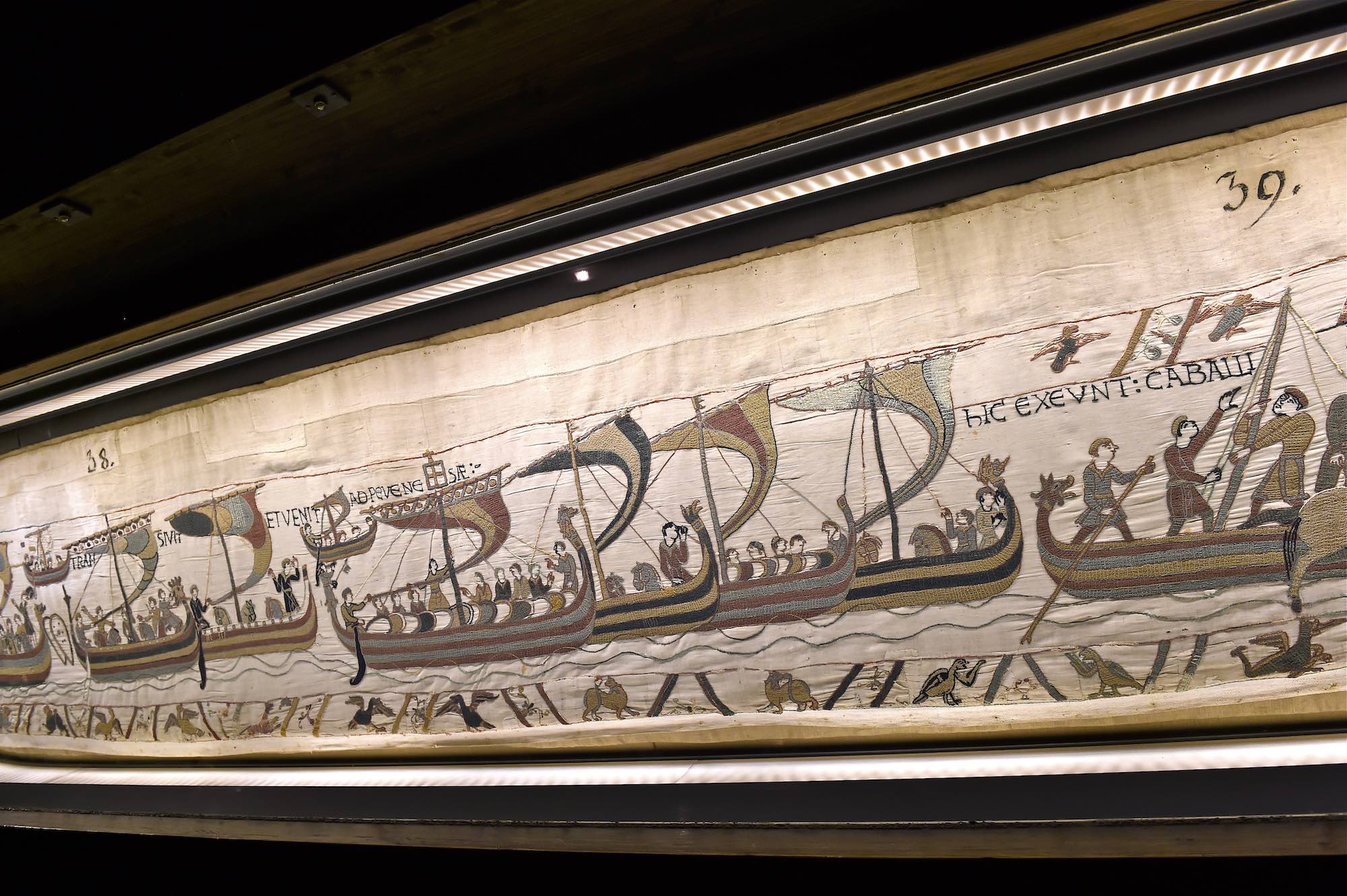
Embroidery known as the Bayeux Tapestry
in its current display
Linen and wool – 50 × 6838 cm
Bayeux, Musée de la Tapisserie de Bayeux
Photo: Mairie de Bayeux (CC BY-SA 4.0)
A curator and medievalist friend confided to us that he initially thought it was a joke from Le Gorafi. Indeed, the entire press has been abuzz with Emmanuel Macron’s promise to Theresa May to lend the Bayeux Tapestry [1] to England. The Élysée Palace press release, although the joint speech by the President of the Republic and the British Prime Minister was ambiguous, is more measured on this point. Paragraph 75 indeed states that this loan would take place “provided that the legal requirements and the scientific conditions of restoration and preservation are met.”
Antoine Verney, Director of the Bayeux Museums, whom we contacted, assured us that “the loan of the work is deemed by all partners as not conceivable given the current understanding of its state of preservation.” However, he did not tell us that the loan was impossible, but rather that it would be subject to a decision following the “preliminary study program prior to any potential conservation/restoration intervention, which aims to stabilize the work by 2022/2023 (?).” Antoine Verney also added that, no more than the French, his British colleagues “would put the tapestry at risk for a publicity stunt.” He thus stated that “a strong institutional partnership involving the British institutions that could be associated with the museographic project, both from a scientific and documentary standpoint – British Museum, Victoria and Albert Museum, British Library, English Heritage… […] is considered a sine qua non condition, which would also aim to support the reflection on the conditions for carrying out this potential loan, which must be studied in all its aspects.”
Antoine Verney further stressed the context, linked to the “project to overhaul the architectural, technical, and museographic program of the current museum.” It is because of this project – which must notably address the conditions of conservation and display of the Bayeux Tapestry – that a very detailed condition report is to be carried out. This project has, for four years, mobilized an international group of curators, art historians, and textile conservators. A call for tenders at the European level was issued but proved unsuccessful. A new call for tenders – likely with a phased approach to the requests and specifications – will be launched again, with successive operations possibly assigned to several teams. The condition report itself must lead to a conservation and/or restoration specification.
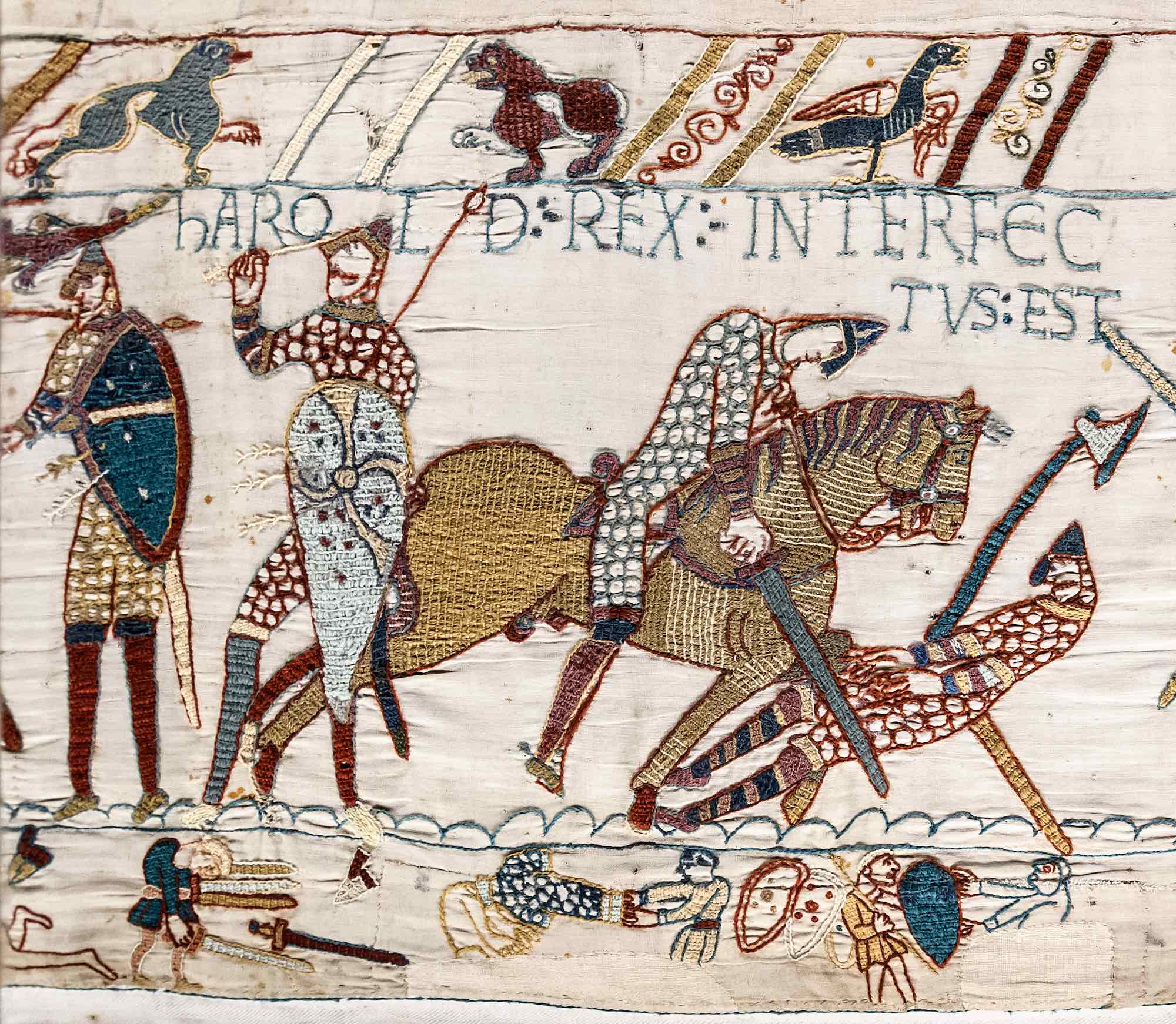
Embroidery known as the Bayeux Tapestry
detail, The Death of King Harold
Linen and wool – 50 × 6838 cm
Bayeux, Musée de la Tapisserie de Bayeux
Photo: Myrabella (public domain)
We therefore see that the curator does not commit to a future loan, even if he does not rule it out. Others are even more cautious about the possibility of the tapestry travelling. We were able to contact two people who are undoubtedly the most familiar with its actual condition, namely two of the three conservators who worked on the piece during the last conservation intervention it underwent, in 1981–1983: Isabelle Bédat and Béatrice Girault. Isabelle Bédat told us that if this thousand-year-old work has reached us in such good apparent condition, it is mainly because it has barely been moved and has always been preserved in the cathedral, away from light, and exhibited only about ten days a year. The work, moreover, had not been restored (Antoine Verney confirmed that the last restoration dates from the 19th century). The 1981–1983 intervention, Béatrice Girault explained, was not a restoration proper. After study, the tapestry was simply backed and then re-backed.
While Isabelle Bédat is doubtful about the possibility of transporting the tapestry – reminding us that all previous loan requests were denied on the grounds that the object was too fragile – Béatrice Girault, now retired and therefore speaking freely, is even more categorical: “Every time it’s handled, a bit of material is lost, and thus a bit of resistance – whether it’s the linen of the base cloth or the wool of the embroidery. The problem isn’t the age, it’s the size. You can’t transport it like a painting in a crate. You can’t roll it because it’s too thin and that causes folds and tension […] The embroidery itself doesn’t need to be reinforced, but the slightest friction, the slightest fold, causes small fibres to come off.” On the possibility of restoration – mentioned as a prerequisite to any transport – she is no less adamant: “It cannot be restored in a way that would make its transport risk-free. It’s not like a sculpture that can be reinforced. The entire material is fragile in itself and requires the least possible handling.” She recalls that, at the time, many questions were raised, particularly about 19th-century restorations: “We wondered whether we should remove the old restorations in favour of more discreet ones. And the answer was no, because they are part of the object’s history – whether on the cloth or the embroidery itself.”
The two conservators highlight another obvious point: it would create a precedent. Béatrice Girault expresses concern: “Why not then send it across the Atlantic or to Japan? It would open the floodgates to all kinds of requests, and politically, it could become difficult to refuse for some what was accepted for others. All of this is dangerous for the work.”
It is therefore clear that what plain common sense suggests to any art lover – that one does not move, without an overwhelming reason, a 70-metre-long textile that is among the most precious works of humanity – is a view shared by professionals. Now that the idea has been floated, they should at least be given full voice and be allowed to decide, entirely independently, on the feasibility of this loan. Once again, Antoine Verney seeks to reassure us, explaining that the decision will be made solely on the basis of the study to be conducted, and that the City of Bayeux will never take any risk regarding the tapestry, emphasizing – and he is right on this point – that the municipality’s agreement is required [2]. But who seriously believes that the political authorities will not, ultimately, have the final say if they are determined to make this loan happen? Certainly not François Neveux, a renowned medievalist and president of the international scientific committee in charge of the museographic project, who told France Info: “If I were the only one to decide on the loan, I would say no” and nevertheless confided to us: “In any case, the reality is that this is a political decision. Let’s not delude ourselves. If the President of the Republic truly wants it, I don’t see how we could avoid it or how the city could refuse it.” Moreover, few journalists use the conditional, as if the decision were already irrevocable.
We may therefore fear the worst from this idea – not absurd in principle (the work is indeed of great significance for the history of England) but irresponsible in practice. One should not restore a work that does not require it simply to make it transportable (which, in any case, is an illusion). Nor should the most precious and fragile works of art be used as diplomatic tools. Clearly, Emmanuel Macron has understood this no better than his predecessors. We will, of course, continue to follow this unfortunate matter very closely.