
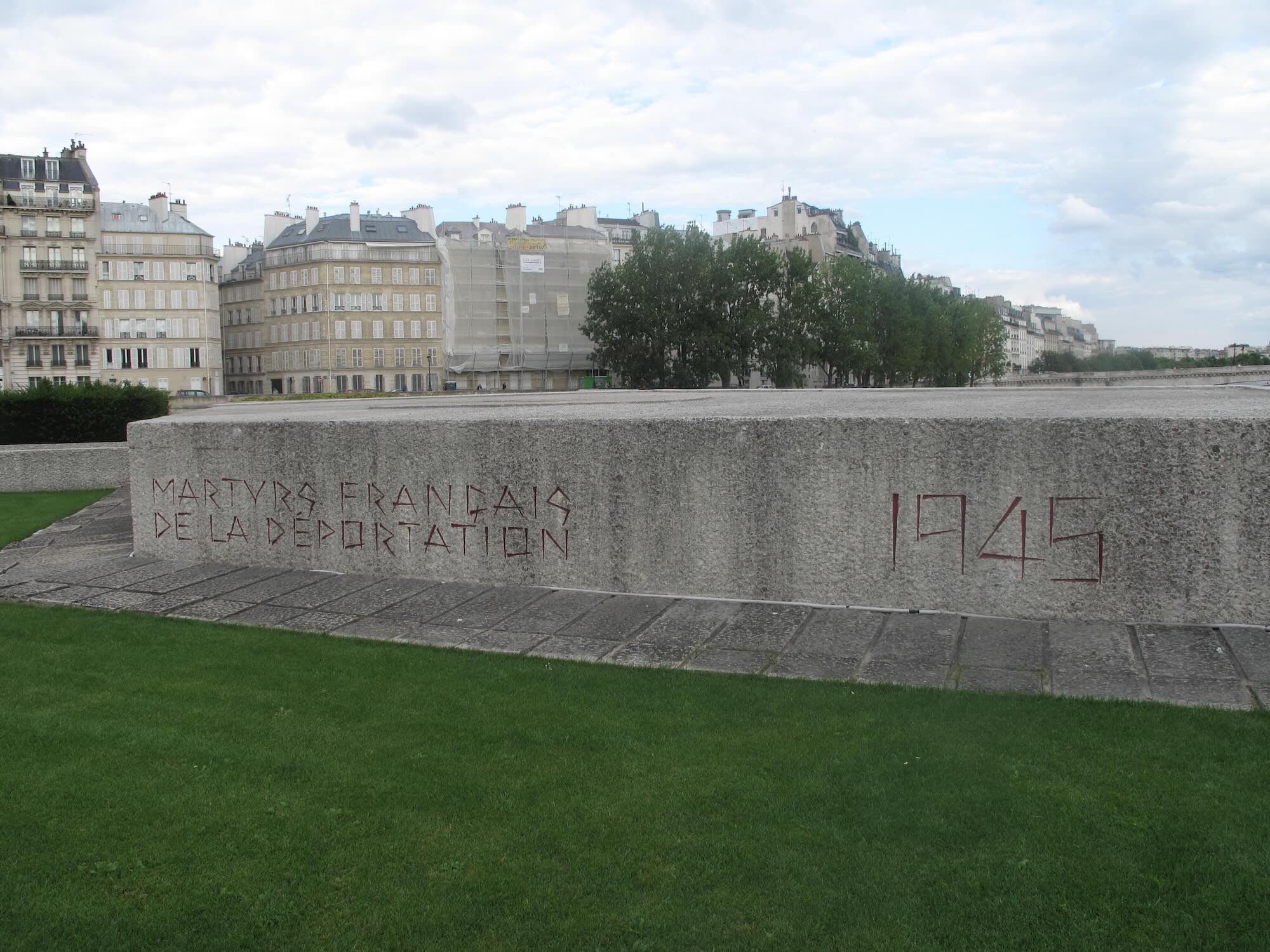
Photo: Wikimedia (public domain)
My attention was recently drawn to the changes envisaged by the City of Paris as part of the redevelopment of the area around Notre-Dame, and more particularly to those that would affect the architectural and commemorative route leading to the Memorial to the Martyrs of the Deportation at the eastern tip of the Île de la Cité.
I visited the monument again in the company of Mr Didier Rykner and Mr Baptiste Gianeselli. The visit is deeply moving. At every step, it makes one understand and feel that the memory of the suffering endured by the deportees is present long before one enters the building. One emerges profoundly shaken by the experience.
This was the intention of my great-uncle, Georges-Henri Pingusson. As he described in his project and as he implemented it, the visit begins as soon as one passes through the gates that he himself designed. The visitor then enters upon a path of contemplation, silence and anticipation, intended to help them understand the barbarity denounced by this monument.
This time is essential to understanding the meaning and the pain of the place. To truncate this route in any way is not a minor matter: it is to damage the work as a whole and the power to transmit memory that its architect intended it to possess.
As a holder of the rights to Georges-Henri Pingusson’s work, I should, at the very least, have been informed in advance of such major alterations to his work. I deeply regret that I was not. As an architect myself, I could also have brought an informed perspective to this project.
The heirs of Georges-Henri Pingusson, as holders of the rights to his work and defenders of his moral rights, oppose this disfigurement of the work. They intend to bring this matter before the public and, if necessary, take the appropriate legal action.
It is first and foremost a duty towards the deportees to whom this place pays tribute, towards their families and towards the memory of what they endured, which we have a responsibility to pass on intact to future generations. It is also a duty towards our forebear, who conceived each stage of this route as an inseparable part of the Memorial.
Finally, it is a duty towards the architects and architecture students who study the full extent of his remarkably modern work, towards all the Maisons de l’Architecture and the Cité de l’architecture, which permanently exhibit his work throughout France, and towards the European and international researchers who regularly send us their publications.
The Memorial to the Martyrs of the Deportation is a work that begins at the gates, in their present location. The monument, its garden and the route leading to it form an indivisible architectural and commemorative whole, which must be respected as such.
Philippe Pingusson
Architect and representative of the moral rights of Georges-Henri Pingusson.